A Guide for Artists

Showing Your Prints in Situ

The how and why of creating in-room mockups that help collectors imagine your work on their walls — the tools worth using, and the mistakes worth avoiding.

Selling a print online is asking someone to buy something they've never seen on a wall.
The Problem, in One Line
Why in-room mockups matter

Closing the distance between a file and a wall.

A flat image of a print — floating alone on white, cropped tight — tells a collector almost nothing about how the work will live in their home. How big is it really? Will it hold the room? Will it feel right above the sofa, or disappear against the wall colour?

A good in-room mockup answers those questions before the buyer has to ask them. It places your print into a plausible interior, at a believable scale, and invites the viewer to picture it on a wall they actually live with. That small imaginative step is often the difference between a browse and a purchase.

The trap to avoid is the opposite one: rooms so artfully staged around the art that they stop looking like real homes. If the sofa is chosen to match the painting, the viewer can tell — and the spell breaks.

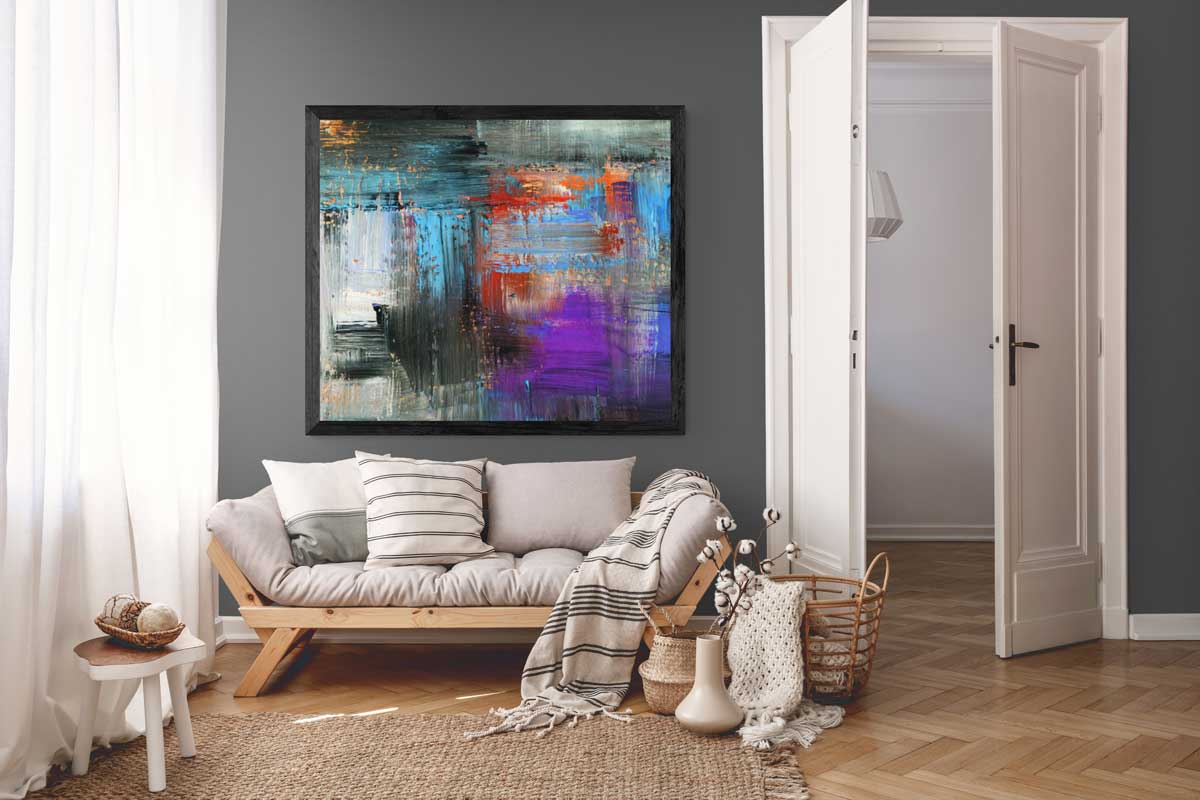
A framed print hung above a sofa in a warmly lit living room, shown at a plausible domestic scale.
A good mockup answers scale, light and context — the three questions every collector asks before they'll consider buying a print they've never seen.
The Landscape of Tools

Five approaches worth considering

The mockup space has shifted considerably in the last few years. Here's an honest look at the main options — each has its strengths and its ideal user.

For painters & poster artists

Canvy

A Danish browser-based app with a library of around 1,500 hand-built room scenes. Strong focus on realism — adjustable wall colours, furniture recolouring, multi-print placement. Includes a simple portfolio website builder and Etsy integration.

  • Large library of hand-built rooms
  • Colour-adjustable furniture & walls
  • Free tier available (limited rooms)
  • Etsy export built in
Free tier; Pro around $15/mo Visit
For galleries & serious sellers

ArtPlacer

More sophisticated than most — over 2,800 rooms, plus augmented reality via a free mobile app. A collector can point their phone at their own wall and see your print at true scale. Also offers website widgets so you can embed AR previews into your own shop.

  • Augmented reality on buyer's phone
  • Embeddable AR widget for your website
  • Virtual 3D galleries
  • Used by galleries & curators
7-day trial; premium tiers Visit
For Etsy & volume sellers

Placeit

Owned by Envato. Hundreds of wall-art templates, unlimited downloads on subscription, and a workflow built for producing lifestyle images quickly. Less specialised for fine art than Canvy or ArtPlacer, but unbeatable if you need ten mockups before lunch.

  • Huge template library across all products
  • Fast, batch-friendly workflow
  • Strong for print-on-demand listings
  • Subscription, unlimited downloads
Subscription from ~$8/mo Visit
For speed & custom scenes

AI Mockup Generators

A newer category — tools like Kittl, Mockey AI and Recraft use generative AI to build rooms on demand from a text prompt. Describe the scene you want and the tool creates it. Faster than a library approach, but results vary and occasional uncanny details creep in.

  • Generate rooms from a text prompt
  • Useful for unusual settings
  • Most have free tiers
  • Watch for uncanny lighting or objects
Free tiers; paid upgrades Explore
For distinctive personal brands

Your Own Photographs

The most overlooked option. A print hung in your actual studio, home, or a borrowed gallery wall — photographed carefully with natural light — carries something no library can replicate. It's unmistakeably yours. If your brand rests on a strong personal aesthetic, this is worth the effort.

  • Unforgeable authenticity
  • No subscription, no watermarks
  • Works across every platform
  • Needs decent camera & light
Your time & a camera
The Design Principle
“The best mockup is the one a collector doesn't notice. Your art is what they should be looking at — everything else in the frame should recede.”
A useful rule of thumb
What Works — and What Doesn't

Six practical tips, whichever tool you use

These apply whether you're using Canvy, photographing your own home, or building rooms from AI prompts.

1

Anchor the scale

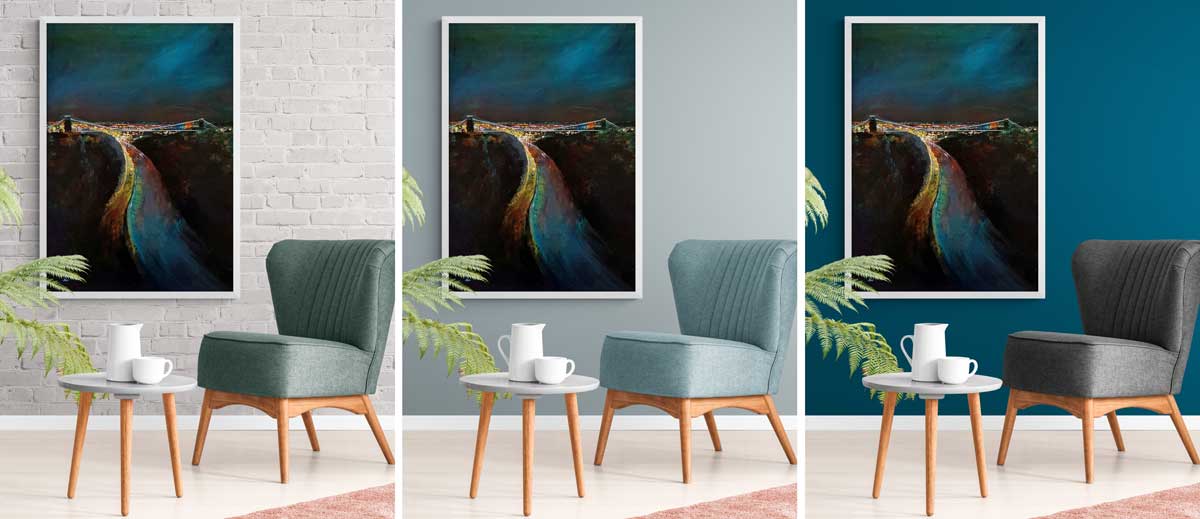
A print above a sofa, a chair, or a doorway reads as a specific size. A print floating on a blank wall could be six inches or six feet. Always include a recognisable piece of furniture or architectural detail.

2

Resist over-staging

If the cushion colour, the pot plant, and the wall paint all echo your painting, viewers will sense the room was built around the art. That undermines the realism that makes mockups work in the first place.

3

Vary the rooms across a series

If you publish ten prints all in the same mockup room, regular visitors to your Instagram or shop will start seeing the template, not the art. Mix your scenes, mix the wall colours, mix the camera angles.

4

Match the room to the audience

A serious abstract expressionist piece looks odd in a floral-cushioned country cottage. A whimsical children's illustration looks lost in a minimalist loft. Think about who buys your work, and what their homes actually look like.

5

Always include one clean shot

Not every buyer wants to see your work in a styled room. Collectors and interior designers often want the print itself — cropped close, on a neutral backdrop, with the paper texture visible. Include at least one of these in every listing.

6

Keep consistency across channels

Your Instagram grid, your Etsy shop, your own website — if each uses a different visual treatment for the same prints, buyers get disoriented. Pick a mockup style, stick with it for a season, and let your audience learn your visual language.

A grid of six in-room mockups showing the same print placed in different interiors — a bedroom, a dining area, a minimalist lounge, a study, a hallway, and a kitchen.
The same print, six different rooms. Varying the aesthetic across a series keeps a catalogue feeling fresh and reaches the widest possible audience.
Before the mockup

Start with a print worth showing

No mockup rescues a mediocre print. If you're selling work online, the paper, the inks, and the finishing are what your collector will eventually unbox and live with. That part happens in the studio, not on screen — and it's what we've been helping artists get right since 1982.

Questions? Give us a call 0117 952 0105